Showing posts with label The Guardian. Show all posts

Saturday, November 22, 2014

You Have to Pay for the Public Life

Proposed Pier 55 Park, New York, by Thomas Heatherwick

"There’s a combination, it seems, of trees and water and fairytale stories told by a charming inventor, that persuades people to part with many millions – and allows conventional urban planning to be gleefully suspended."
Oliver Wainwright

The Guardian's Oliver Wainwright weighs in on Barry Diller's proposed US $130 million park and performance pier on the Hudson, designed by Thomas Heatherwick. It turns out that Heatherwick is behind another park on the water proposed for London, this time for a Garden Bridge across the Thames.


Proposed Garden Bridge, London, by Thomas Heatherwick

Oliver Wainwright
Thomas Heatherwick plans $170m hovering miracle island for New York
The Guardian
 Nov 18, 2014

London's garden bridge: the public park where groups and cyclists aren't welcome
The Guardian
 Nov 19, 2014

A more complete view on London from the BD Journal (registration required):
David Rogers
Garden Bridge says parties of 8 are 'protest risk'
BD Online
Nov 19, 2014

(See also Addendum at end of this entry).

London's Garden Bridge is sponsored by a non-profit trust and will be built with public and private funds. On plans to restrict access for cyclists, protesters and large groups, Wainwright charges:
"Such a measure suggests that the garden bridge, as its critics have suspected, is not in fact a bridge – in the sense of being a public right of way across the river – but another privately managed tourist attraction, on which £60m of public money is to be lavished."
Wainwright points out the Disneyfied quality of both projects:
"It is another vision that could come straight from the set of Avatar – fecund flowerbeds erupting from mushroom-shaped columns, their canopies joining to support parkland above the water." 
Is this another step in the tacky Hollywoodization of public space, its commodification and conversion into entertainment and cheap fantasy? The next step up from the theme restaurants and clubs of the 1990s, such as those in New York designed by Broadway set designer John Rockwell? Though actually, peering through the fog of the atmospheric renderings, I don't think these places look all that bad.

Charles Moore famously said of the original Disneyland, "You have to pay for the public life". Public spaces have gotten better in New York with private involvement, as in Central Park. Though sometimes the tradeoffs are steep, as in Bryant Park. The alternative seems to be abandon and neglect. Or of course grass-roots community gardens, another form of privatization.

Maybe Diller and the Garden Bridge Trust are just following the example of Gordon Matta-Clark, carving new public spaces out of abandoned city piers, chain saw in hand.

Gordon Matta-Clark's "indoor water park", Day's End. Intervention on an abandoned New York pier, 1975. Source: Light Industry
Addendum
November 30, 2014

Rowan Moore, writing in The Observer, has also condemned the Garden Bridge proposal in an article published on November 22nd:
"The bridge’s fans back it with good intentions. They want something beautiful. They believe that a great city shouldn’t stand still. They are right to explore ideas like this. But there comes a time to recognise that the thing they love is not what they thought it would be, that their nice idea just doesn’t work. It is not a tranquil walk in woodlands. It is not a genuinely public place. It is not free. It is not a well-conceived piece of transport infrastructure. It is a crowded and overstyled chunk of heavy engineering garnished with urban parsley."
 Rowan Moore
The Thames garden bridge is nothing but a wasteful blight
The Observer
November 22, 2014

 Can't resist: one of the reader comments in favor of the bridge:
"Quite. A well travelled person said to me when I was a teenager that England is the best country in the world. Since then I've been very lucky to have travelled as much as he had and I think he was right. London especially has so much diversity in its appeal that an original idea like this one should be celebrated and as you suggest, if you don't do it why do anything at all?" 
I'm glad this person took the trouble to confirm his prejudices; I see he has made good use of all his traveling about.

Saturday, April 5, 2014

Virtual Reality Blues

sydney kramer business insider oculus rift
William Wei, Business Insider
Mark Zuckerburg on his latest purchase, Oculus, goggles that immerse video game players in virtual reality, as reported in Business Insider
"After games, we're going to make Oculus a platform for many other experiences. Imagine enjoying a court side seat at a game, studying in a classroom of students and teachers all over the world or consulting with a doctor face-to-face -- just by putting on goggles in your home."
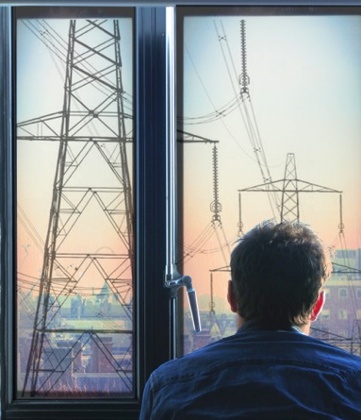
And an April Fool's Day post in The Guardian on InstaWindows for refurbishing England's public housing:
 "If you're addicted to adding filters to your Instagram snaps, and wish you could always see the world in grainy high contrast or with that sun-kissed glow, help may be at hand. As part of the government's Happy Homes initiative, which will see swathes of ailing council blocks retrofitted with colourful cladding panels and wood-effect flooring over the next five years, tenants will also be given the chance to transform their windows with the application of a tinted filter."
"'The Instawindow is designed to transform even the bleakest views of post-industrial wastelands into picture-postcard visions that you'll be dying to share with your friends,' says Daisy Faropoll, head of brand at Happy Homes. 'Whether you prefer that permanent sunset look, or like your colours super-saturated, our range of filters caters to every mood. And with an easy-peel backing, you can keep mixing it up and curate your own personalised viewscape each day.' "
As always, parody and reality are never far apart.
Permanent sunset … The window filters are designed to transform even the bleakest prospects into 'picture-postcard views you'll be dying to share with your friends'
The Guardian

Post edited April 11, 2014


Wednesday, June 6, 2012

It's Summer Again at the Serpentine


Rowan Moore in The Guardian on this summer's Serpentine Pavilion in London by HdM and Weiwei. (Skip-scroll through the intro about how tiresome Thomas Heatherwick is).

Quote:
"What you get now is a sunken bowl lined with series of descending terraces, with fragments of curved and angled lines that echo the bygone works of Sanaa, Gehry, Hadid, Libeskind, Eliasson and others. It's surfaced with dark brown compressed cork which looks like mud from a distance and is firm but slightly yielding underfoot. It also gives off an organic scent. Above is a horizontal disc, propped on a basic structure like the covering of an archaeological dig, holding a film of water."
"The surrounding land slopes, which means that at different places you can see over the top of the disc and appreciate the reflections it makes of trees and sky, or look into the cave-like space it covers, with fragmentary views of the park beyond. The interior ... is an events space, cafe and place for sitting around, except that this time it was felt that the concept would be compromised by installing catering facilities. These are provided by a matter-of-fact trailer parked close by."

Photo from the article
Oli Scarff/Getty Images

Monday, June 4, 2012

London's Olympics on the Horizon


Architectural Record's June issue devotes extensive coverage to the London Olympics, and to London in general. See a list of articles with links here.

The issue includes my brief overview of the lasting effects of the Olympics in Barcelona and Athens.
"For the Greeks, the 2004 Olympics in Athens and the aftermath have become a symbol for everything that has gone wrong in their country..."
"Barcelona used the investments and positive energy generated by the 1992 Olympic Games as a tool for long-term strategic planning—a model that London studied closely...." 
 In an excellent article in The Guardian, Rowan Moore also weighs in on London's Olympic effort (link), calling into question the whole enterprise of the Games.

The article includes links about some of the Olympic projects, such as Anish Kapoor's and Cecil Balmont's Orbit sculpture,  (photo above, apparently sporting an impressive phallus), on which Moore comments, "it will cost £15 to go up to the top. I suggest that residents of nearby council tower blocks charge £14.95 to visit their flats. The view will be just as good and visitors would gain a richer understanding of London and of humanity".

 Other venues:
Aquatic Center by Zaha Hadid.
Velodrome by Hopkins Architects.
Athletic Stadium, sponsored by Dow Chemical.
Olympic Village (in a separate review by Rowan Moore).
Olympic Park by George Harrgreaves (gets a thumbs-up from Moore for preserving a sense of the pre-existing context amid the waterways of the River Lea).

Thursday, January 19, 2012

Koolhaas at the Barbican


Exhibitions

OMA/Progress 
Through 19 February
Barbican Art Gallery
London

Though open since October, this major retrospective has attracted the attention of Architectural Record only now; their review is here.

And The New York Times? Michael Kimmelman is kool to the old favs of Ouroussoff and Muschamp, and his last post was on parking lots.

But Rowan Moore reviewed the Koolhaas show in The Guardian in October; the review is here.

So run right over.
And add The Guardian to your list of RSS feeds.

Note the show's location at the much-maligned Barbican, which now has it's defenders.
Is Koolhaas one?

Photo © OMA / Barbican Art Gallery
From Architectural Record's slideshow on the show

Monday, July 11, 2011

Hadid's Seville Library to be Demolished

In September 2009 I reported in Architectural Record on the court case to halt construction of the new central library for the University of Seville, designed by Zaha Hadid. After a local court ruled against the project, the case made its way to Spain's highest court, the Tribunal Supremo, which handed down its unappealable decision late last month: Hadid's project, partially completed at a cost of roughly 4 million euros, must be demolished (El País 06.26.11).

The suit was brought by a group of neighborhood residents who objected to the construction of the building in a public park, situated near the Plaza de España and other university buildings.  The court ruled that the city's and university's decision to sacrifice part of the park for the project  --about 8% of its total area--  was not sufficiently justified. The project's backers, the court ruled, had not presented sufficient evidence for why the library could not be built elsewhere.

City and university authorities now plan to meet to find another site for the library.

Until recently, politicians in Spain have enjoyed a surprisingly free hand in making important planning decisions such as this, with minimal public comment, participation or protest. But as the case shows, this began to change even before the current crisis.

The neighbors who brought the suit were openly hostile to the Hadid design. Why is it always Hadid who attracts such hostility? Why is it always Hadid who is made to pay for the public's most reactionary instincts? There are certainly others more deserving of public ire, but these are the same who tend to become public idols.

Local politicians throughout Spain have allowed themselves to be over-dazzled by big architectural names, and the case of Hadid in Seville is no exception. But the responsibility for this fiasco in court is clearly theirs, not hers.

In my 2009 article, Hadid’s project architect for the project, Sophie Le Bienvenu, explained that the building "lifts off the ground, so that the gardens extend under it." She pointed out that it will be open to the general public. “It's an addition to the park that promotes the city’s cultural life,” she says. “The park will still be there, and people will be able to enjoy it more.”


Meanwhile work proceeds on Cesar Pelli's 43-story bank tower in the center of Seville that opponents  say will destroy the city's historic skyline, and that has UNESCO threatening to put Seville on its list of endangered heritage sites. But that's another story.....


 And on a brighter note, Jürgen Mayer H's Metropol Parasol in Seville's Plaza de la Encarnación, with its gigantic glulam domes, has finally opened. From Rowan Moore's lively review in The Guardian last March:
Oh my God, it's an icon. How very last decade. Did the city of Seville not get the memo? Big, flashy buildings are out; hair shirts are in.
Top, Photo montage of library by Studio of Zaha Hadid
Middle, Photo montage of Pelli tower from El Mundo, 06.22.09
Bottom, Photo © Roland Halbe